In-vivo Raman delivery study · 03
FolliGenz × CTI: Live-Human Raman Mapping of a 10% Minoxidil-Sulfate Emulsion
A potentially first-of-its-kind human in-vivo confocal Raman time course built around one foundational delivery question: could the submitted minoxidil-sulfate formulation generate a detectable signal beyond the skin's outer barrier, and would that signal continue moving deeper over four hours?
- Organizations
- FolliGenz Therapeutics Corporation × Centre Testing International Group Co., Ltd.
- Project period
- January to March 2026
- Prepared by
- Biotica Consulting LLC
- Last reviewed
- July 31, 2026
- Status
- Completed laboratory test report
- Format
- Third-party in-vivo penetration study
This page summarizes an entrusted-testing report and a related LIMS screenshot supplied by FolliGenz. FolliGenz was the named customer and supplied the 10% emulsion; Centre Testing International Group Co., Ltd. conducted and reported the Raman laboratory study. Biotica prepared this evidence-bounded summary and omitted subject identifiers, signatures, and other nonessential personal details. The LIMS image retains only the project sample and manufacturer metadata visible in the supplied screen.
The development question and the work behind it
FolliGenz commissioned CTI to investigate a difficult and unusually specific formulation question. Instead of relying only on an excised-skin diffusion model, the team wanted to observe whether a 10% minoxidil-sulfate emulsion could produce a measurable, depth-resolved chemical signal inside intact living human skin. A literature search completed in July 2026 found earlier minoxidil delivery work using radiolabeling and earlier minoxidil-sulfate work using Franz cells and confocal laser microscopy, but did not identify an earlier published human in-vivo confocal Raman time course of topically applied minoxidil sulfate. To our knowledge, this appears to be the first reported application in that narrow category, although unpublished, private, or unindexed work cannot be excluded.
CTI enrolled three healthy women aged 28 to 37. After the inner forearms were washed with water, dried, and equilibrated for 30 minutes at 21 ± 1 °C and 50 ± 10% relative humidity, a trained technician marked four 3 × 3 cm areas for separate measurement times. Baseline spectra were collected, merchant information was removed from the sample packaging, and the submitted emulsion was applied once at 4.0 ± 0.1 mg/cm². An RZ660 In Vivo Raman Analyzer then scanned designated sites at 1, 2, and 4 hours to a nominal depth of 60 µm. CTI processed the raw spectra with LabSpec6 and generated the reported outputs with Origin 8.
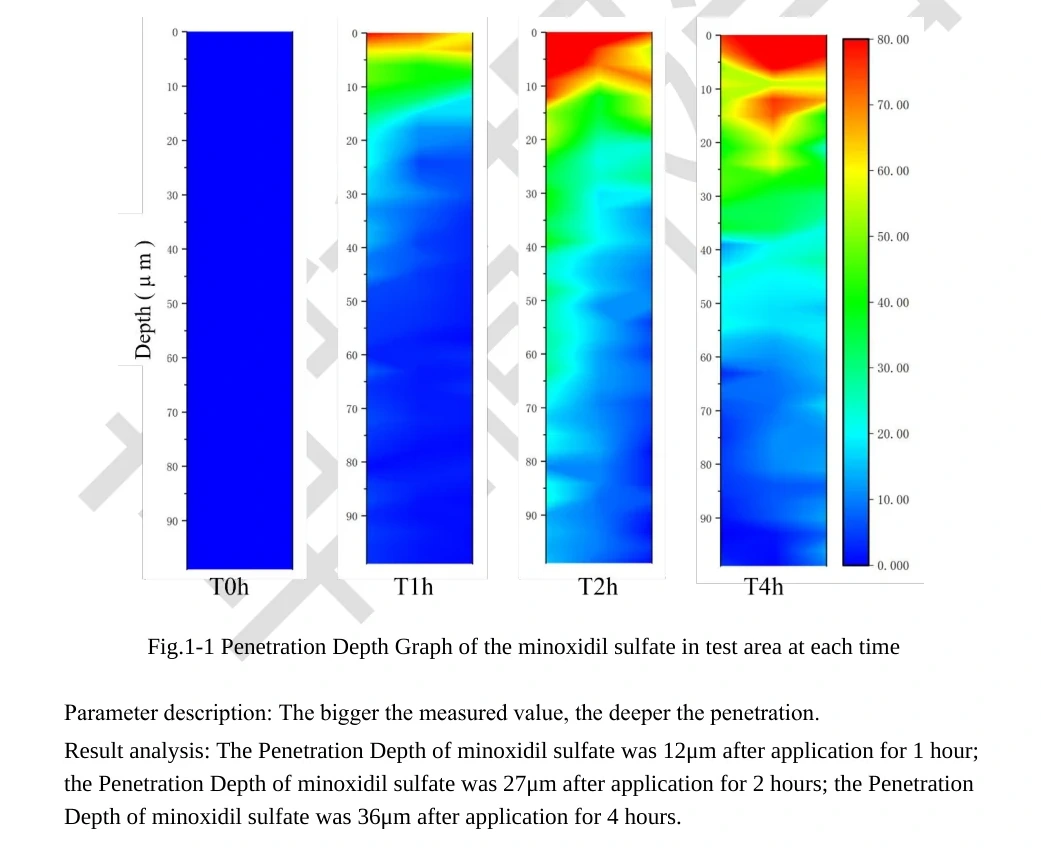
The time course produced a clear directional signal. CTI reported detection to 12 µm at 1 hour, 27 µm at 2 hours, and 36 µm at 4 hours. Reported mean penetration content increased in the same order from 24.934 to 55.854 to 68.944 µg/cm². From the first to the final measurement, reported depth tripled and content increased approximately 2.76-fold. The study was small and did not report inferential statistics, but both derived endpoints moved in one direction at every scheduled time point. That gave the development team the signal it was looking for: the formulation-associated output did not remain confined to the immediate surface and continued extending deeper through four hours.
The stratum corneum is the skin's outer barrier and the key first hurdle in topical delivery. Published in-vivo Raman research estimated mean apparent stratum-corneum thickness at 22.6 µm on the volar forearm, although thickness varies by person, site, age, and hydration. Against that reference, CTI's later reported depths of 27 and 36 µm are consistent with movement beyond the average outer-barrier range. CTI did not independently map the stratum-corneum boundary in each participant, so this is an encouraging depth signal rather than direct histological proof that every participant crossed a measured layer boundary.
For this particular question, live-human Raman testing offered an important advantage over a conventional Franz diffusion cell. It followed a chemical signal noninvasively at successive depths in intact living human skin without excising the tissue, mounting it over a receptor chamber, or destructively processing a skin sample at each time point. Franz cells remain highly valuable for standardized formulation comparisons, receptor-fluid permeation kinetics, and mass-balance recovery. The approaches are complementary, but Raman was more physiologically direct for FolliGenz's immediate question about where the formulation-associated signal appeared in living skin over time.
Depth-resolved evidence from the submitted sample
The depth profile extends with each measured time point
CTI's concentration-versus-depth figure shows a longer detectable profile at each scheduled measurement. The animation uses the report's original vector paths, coordinates, stroke weights, and colors. It adds no markers, effects, or interpolated values.
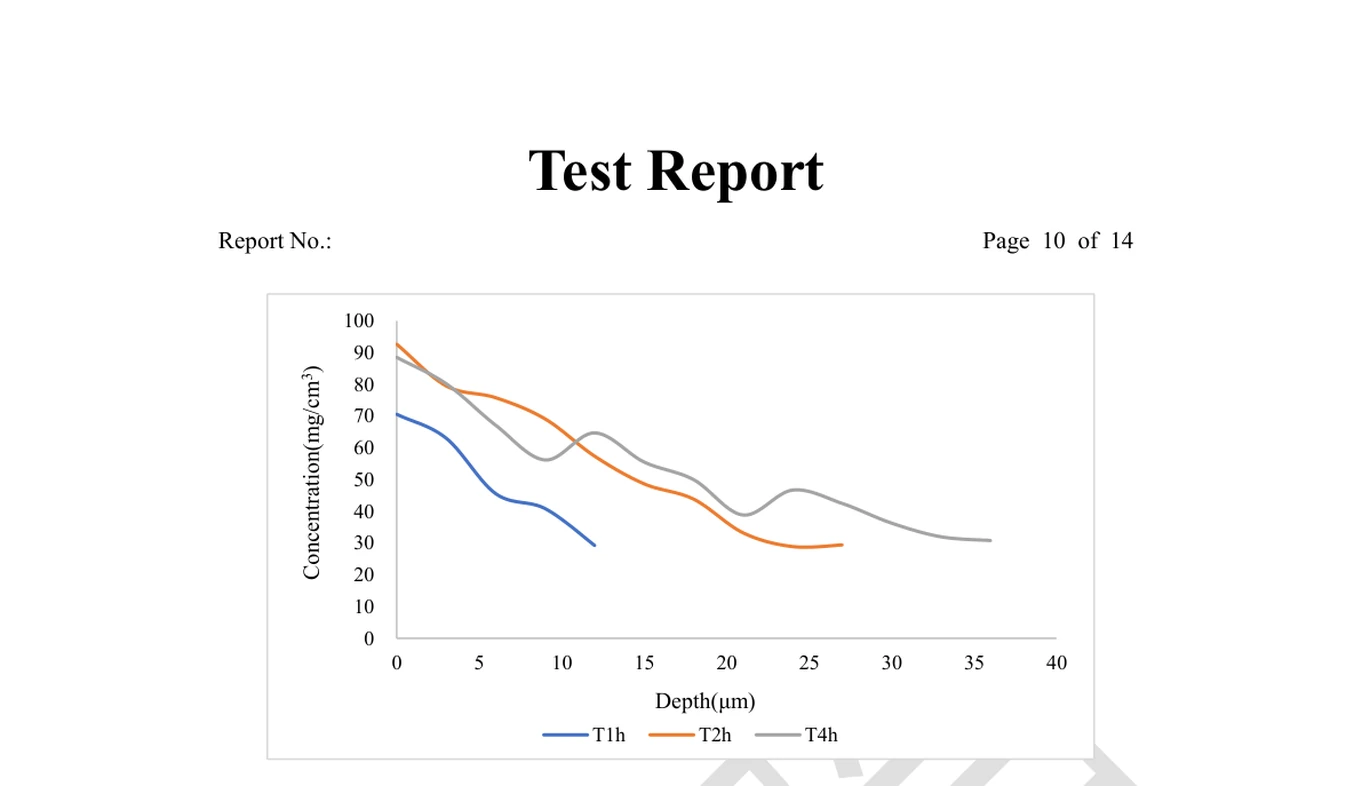
- 1 hour12 µm24.934 µg/cm² mean penetration content
- 2 hours27 µm55.854 µg/cm² mean penetration content
- 4 hours36 µm68.944 µg/cm² mean penetration content
Defined roles across the project
FolliGenz Therapeutics Corporation
Commissioned the entrusted test, supplied two bottles of the 10% minoxidil-sulfate emulsion, and used the study to answer a formulation-development question about detectable skin penetration over time.
Centre Testing International Group Co., Ltd.
Blinded the submitted sample, recruited and screened participants, controlled application and environmental conditions, collected depth-resolved Raman spectra, analyzed the data, and issued the test report.
A traceable development path
- 01
Sample received and testing opened
CTI recorded receipt of two 60 mL bottles of the submitted 10% emulsion and began the entrusted-testing program.
- 02
Controlled Raman measurements
CTI completed baseline and post-application scans, processed spectra with LabSpec6, and used Origin 8 for the reported statistical outputs.
- 03
Depth and content results documented
The final report summarized the N=3 measurements, reported no immediate adverse reactions during the test, and limited responsibility to the submitted samples and study conditions.
How CTI structured the stability program
The Raman report answers a penetration question. This separate project-supplied CTI laboratory information management system screen shows how the same SulfoGenz Minoxidil-Sulfate 10% sample identity was logged for a stability workflow. It is a scheduling and sample-intake record, not a Raman data screen or an analytical-results table.
The upper pane contains five visible LIMS work lines. The first is a D0 baseline package. The next three are accelerated-stability packages under a condition visibly beginning at 40 °C ± 2 °C and RH 75%, with the remaining humidity detail cropped from the screen. The fifth line instructs the system to combine samples 001 and 002 into one report. That means the screen shows four testing packages plus one consolidated reporting package, not five independent analytical tests. It does not enumerate the individual assays or replicate counts inside each package.
The visible Test Cycle values are 6.00, 30.00, 48.00, and 69.00, with 69.00 repeated for the consolidated-report line. The screen does not display a unit, so these values are reported exactly as LIMS cycle fields rather than being converted into days or stability checkpoints. Estimated report dates progress from January 14 to February 24, March 19, and April 20, 2026. The final accelerated package and combined report share the red-boxed April 20 deadline. These are projected reporting dates, not proof that the reports were issued or that the sample passed.
The lower Sample Information pane adds traceability. It identifies a SulfoGenz 10% minoxidil-sulfate emulsion, lot 80985087/1, supplied as 28 bottles of 60 mL each, with Manipula visible as the manufacturer. The Production Date/Shelf Life field reads September 2025 / 1 YEAR. That one-year entry is submitted sample metadata, not a stand-alone CTI stability conclusion. The neighboring Test Information, Sample Photos, and Original Record Archive tabs show how the LIMS connects scheduling, identity, imagery, and source records around the submitted material.
Five work lines: four testing packages and one reporting package
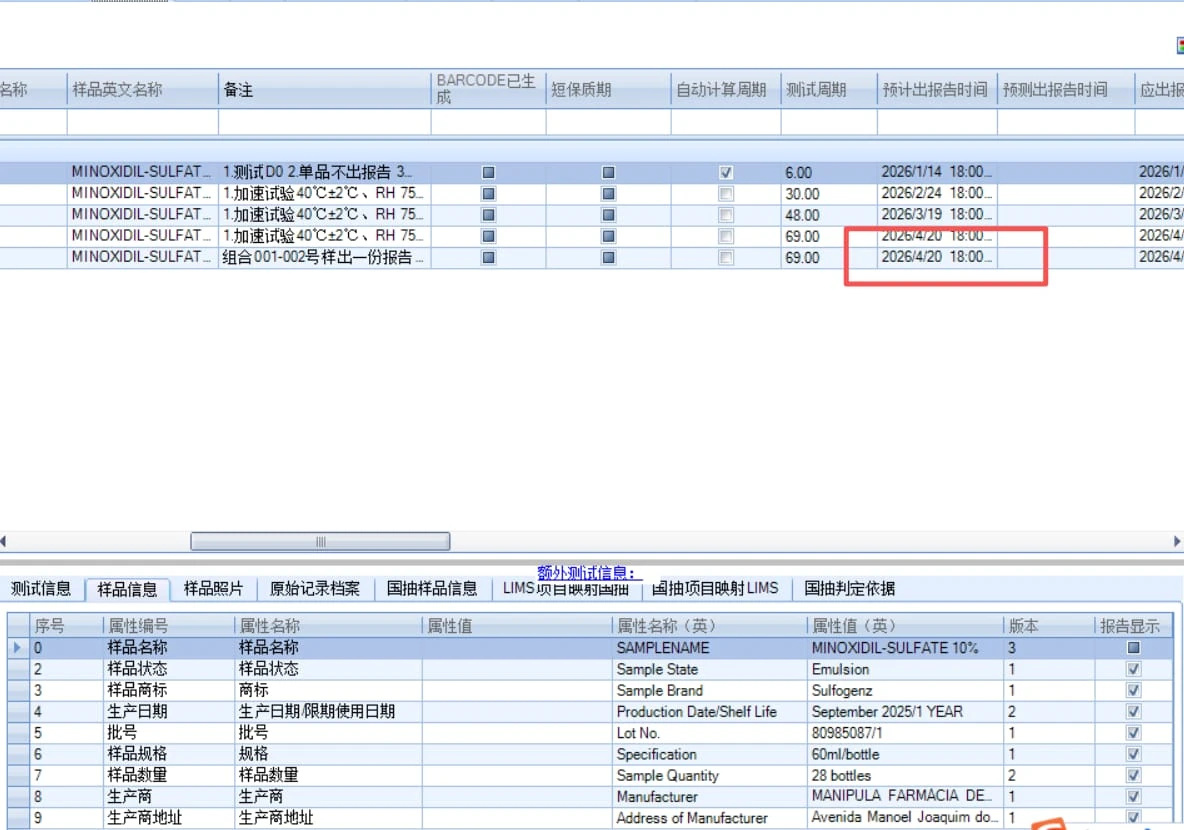
CTI LIMS project view for the submitted SulfoGenz Minoxidil-Sulfate 10% emulsion. The upper pane schedules D0, three accelerated-stability work packages, and one consolidated report. The lower pane records the sample identity, lot, bottle configuration, quantity, and manufacturer. Scheduling entries and sample metadata should not be read as completed assay results.
This screen documents sample intake, four scheduled testing packages, and one reporting instruction. It does not display analytical results, acceptance criteria, completion status, pass or fail determinations, or a CTI-validated shelf-life conclusion. The 28-bottle quantity also does not mean that 28 independent tests were performed.
Questions the work was designed to answer
- Can a minoxidil-sulfate-associated Raman signal be followed beyond the immediate skin surface after one application of the submitted 10% emulsion?
- How do reported penetration depth and penetration content change at 1, 2, and 4 hours?
- Does the four-hour depth profile provide a signal consistent with movement beyond the stratum corneum, the skin's outer barrier?
- Why is a noninvasive live-human Raman time course especially well matched to this development question?
- What can this small forearm study establish, and what remains outside its design?
- How should the project's novelty be described without making an unsupported global priority claim?
What the project record supports
A potentially first-of-its-kind live-human application
A July 2026 literature search found earlier minoxidil and minoxidil-sulfate penetration studies using radiolabeling, Franz cells, or confocal laser microscopy, but no earlier published human in-vivo confocal Raman depth profile of topical minoxidil sulfate. To our knowledge, this appears to be the first reported time-course application in that narrow methodological category. Unpublished, private, or unindexed work cannot be excluded, so this is not an unqualified world-first claim.
The method watched delivery in intact living skin
CTI used separate marked inner-forearm areas on three living participants. After baseline scans and one technician-controlled application, the analyzer collected depth-resolved Raman spectra at 1, 2, and 4 hours while participants remained under controlled environmental conditions. This produced a spatial and temporal view of the analyte-associated signal without excising or destructively processing the skin. The technique is confocal Raman spectroscopy, not Raman mass spectrometry.
Reported detection depth tripled through four hours
CTI reported penetration depths of 12 µm at 1 hour, 27 µm at 2 hours, and 36 µm at 4 hours. The final reported depth was three times the first-hour depth, providing a clear directional time-course signal under the submitted protocol. The deepest displayed detected value was at 36 µm; the report showed no value at 39 µm or deeper.
The later signal is consistent with passing the outer barrier
Published in-vivo Raman research estimated mean apparent stratum-corneum thickness at 22.6 µm on the volar forearm. CTI's 27 and 36 µm outputs extend beyond that reference scale and are consistent with movement beneath the average outer skin barrier. Because CTI did not map each participant's individual layer boundary, this is a contextual interpretation rather than direct layer confirmation.
Reported mean penetration content rose 2.76-fold
Mean penetration content increased from 24.934 µg/cm² at 1 hour to 55.854 µg/cm² at 2 hours and 68.944 µg/cm² at 4 hours. The first-to-final increase was approximately 2.76-fold. This is a trend in CTI's reported aggregate outputs, not proof of statistical significance or superiority over another formulation.
Live-human Raman was the better fit for this question
A Franz cell measures permeation through excised skin into receptor fluid and is useful for controlled flux comparisons and mass balance. In-vivo confocal Raman instead measures a depth-resolved signal directly in intact human skin. That made Raman more directly aligned with FolliGenz's time-and-depth question under living conditions, while leaving Franz testing valuable as a complementary validation method.
A compelling development signal, with clear boundaries
The report states that none of the three participants experienced an adverse reaction during the short test. It presents aggregate outputs without individual data, variability estimates, error bars, hypothesis tests, a vehicle control, or a formulation comparator. The study supports an exploratory live-human penetration trend, not statistical significance, scalp or follicular targeting, product superiority, hair growth, systemic exposure, or long-term safety.
What must be proven before stronger claims
The project record is a development input, not permission to outrun the evidence. These are the next questions for direct testing and review.
- Can the laboratory provide the analyte reference spectrum, preprocessing parameters, calibration model, detection threshold, and method-validation record?
- Would a larger study reproduce the depth and content profiles across sexes, ages, skin types, and application sites?
- How would the submitted emulsion compare with its vehicle, a non-liposomal control, or another minoxidil-sulfate formulation?
- Do scalp or ex-vivo follicular studies show localization relevant to the intended use rather than general forearm distribution?
- What do repeat-dose tolerability, stability, and exposure studies show over the intended product-use period?
- Can a systematic literature and patent review support any claim of global methodological priority?
- Can the authenticated signed-and-sealed report and CTI's permission for any public figure reproduction be archived with the project record?
- Can the issued D0 and accelerated-stability reports, methods, assay list, acceptance criteria, raw observations, and completion records be matched back to the LIMS schedule?
Progress stated at the level the work supports
FolliGenz did more than commission a routine diffusion screen. It asked whether a difficult-to-deliver minoxidil-sulfate formulation could be followed directly inside living human skin, and CTI built a controlled, depth-resolved Raman time course to answer it. After one application, the reported signal progressed from 12 µm at 1 hour to 27 µm at 2 hours and 36 µm at 4 hours, while mean penetration content rose from 24.934 to 68.944 µg/cm². In the context of published volar-forearm stratum-corneum measurements, the later depths provide a meaningful signal consistent with movement beyond the average outer skin barrier. Unlike an excised-skin Franz-cell experiment, this protocol observed the formulation noninvasively under living human conditions. To our knowledge, it is potentially the first documented human in-vivo confocal Raman depth study of topical minoxidil sulfate. It remains an N=3 forearm study, not proof of scalp targeting, comparative superiority, hair growth, systemic exposure, or long-term safety.
FolliGenz and CTI turned a delivery question into a measurable living-human study
Biotica helped frame the sponsor question, align the Raman method with the formulation-development decision, coordinate technical communication, and interpret the four-hour signal within the study limits.
Project records and public sources
The commissioned CTI report is the primary Raman project record and is not a peer-reviewed paper. The related LIMS screenshot documents scheduling and sample intake, not stability results. Public sources provide method and company context; they do not independently reproduce either record. The report restricts partial reproduction, so the authenticated record and CTI reuse permission should be retained for any excerpted figure.
- 01Private project record
CTI Test Report: MINOXIDIL-SULFATE 10% · Sample HBS00029001
Centre Testing International Group Co., Ltd. · Entrusted-testing report · 14 pages · 2026
- 02Private project record
CTI LIMS stability-program schedule and sample-information screen
Centre Testing International Group Co., Ltd. · Supplied LIMS screenshot · 2026
- 03View source
About Centre Testing International
Centre Testing International Group Co., Ltd. · Official company page
- 04View source
FolliGenz Therapeutics R&D Pipeline
FolliGenz Therapeutics Corporation · Official company page
- 05View source
FolliGenz Therapeutics: About Us
FolliGenz Therapeutics Corporation · Official company page
- 06View source
A new paradigm in dermatopharmacokinetics: confocal Raman spectroscopy
PubMed · Peer-reviewed methods study
- 07View source
An in vivo confocal Raman study of the delivery of trans-retinol to the skin
PubMed · Peer-reviewed in-vivo methods study
- 08View source
Franz Cell Diffusion Testing and Quantitative Confocal Raman Spectroscopy: In Vitro-In Vivo Correlation
PubMed Central · Peer-reviewed comparative methods study
- 09View source
In vivo estimation of stratum corneum thickness from water concentration profiles obtained with Raman spectroscopy
PubMed · Peer-reviewed in-vivo methods study
- 10View source
Confocal Raman spectroscopic characterization of dermatopharmacokinetics ex vivo
PubMed · Peer-reviewed methods study
- 11Internal research record
Literature search: minoxidil sulfate and human in-vivo confocal Raman spectroscopy
Biotica Consulting LLC · Multi-database literature-search record · reviewed July 31, 2026
- 12View source
Minoxidil sulfate liposomes for enhanced dermal delivery: Formulation, characterization, and evaluation
PubMed · Peer-reviewed ex-vivo Franz-cell and confocal-microscopy study
- 13View source
In Vivo Skin Penetration of Topical Minoxidil Formulations
PubMed · Peer-reviewed human radiolabel study of minoxidil base
- 14View source
Use of minoxidil sulfate versus minoxidil base in androgenetic alopecia treatment
PubMed Central · Peer-reviewed clinical context review
Project evidence and literature must be read within their stated methods and limitations. This page is not medical, clinical, regulatory, or legal advice.
Related projects and research
Follow adjacent formulation, partner, supplier, and research questions while keeping each evidence type clearly labeled.
Need a development question turned into a testable brief?
Biotica can connect literature review, formulation strategy, partner coordination, market analysis, and a validation roadmap around the decision your team needs to make.
Discuss a development project